 1ContourDiscuss a project
Choosing a large outdoor concrete planter for your site
Start with the surface beneath the planter, the space available for planting and the route the concrete must travel. Those decisions tell you whether a standard open-base design fits.
Compare planter footprintsBy 1Contour · Published · Collection facts checked .
Compare the space each planter occupies
Use outside dimensions to test the footprint on your plan. They do not tell you the usable planting volume or the weight after soil and plants are added; confirm those separately for your actual planting scheme.
| Design | Outside dimensions | Where it can make sense |
|---|---|---|
| Bowl | 48 × 48 × 20 in | A broad, low form where planting can spread across a garden edge. |
| Flute | 36 × 36 × 36 in | A taller focal point with a three-foot square footprint. |
| Ledge | 48 × 12 × 12 in | A narrow strip along a path or planting border. |
Source: 1Contour design pages linked above. These are design descriptions, not planting or engineering specifications.
See an actual printed planter
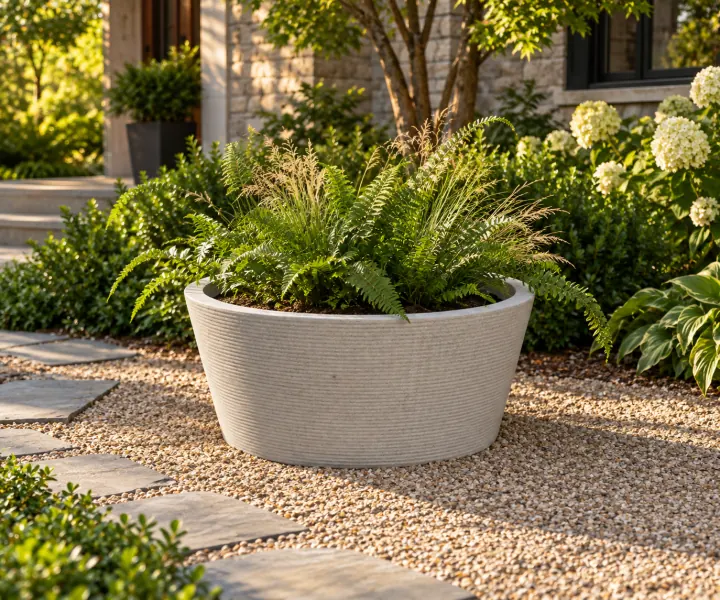
The photograph below shows the layered surface of a printed concrete planter outdoors. It is an example of a real print, not one of the named catalog designs.

Check the base before comparing finishes
Bowl, Flute and Ledge are sold as open-base garden planters for direct planting into soil. Their standard configuration is not a self-contained pot that can hold soil and water on a paved terrace. If the site is paving, a roof deck or an indoor floor, describe the surface and ask 1Contour about a custom base, liner and drainage approach before ordering.
Drainage must suit both the plants and the site. Decide where water should leave the planter and whether the surrounding surface can receive it. A design illustration cannot establish waterproofing or the performance of a custom liner.
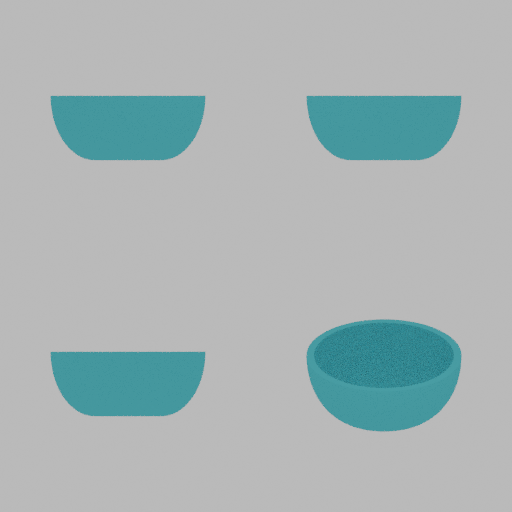
Measure for the planting, not only the illustration
Give the landscape designer or grower the proposed plant species, root-space requirement and irrigation plan. Then ask for the usable inside dimensions of the final design. A 48-inch outside diameter is not 48 inches of soil width. On a balcony or suspended slab, have the responsible project professional review the combined planter, wet soil and planting load before ordering.
For a custom long trough or an unusual planting depth, start from a sketch with overall width, depth and height. 1Contour’s custom planter collection explains the design review. A different size is a new manufacturing brief and needs its own quote.
Trace the delivery route to the final spot
Write down the delivery ZIP, driveway access, narrowest gate, turns, steps and any slope between the unloading point and the final position. Photograph those constraints with a tape measure in the frame. If equipment may be required to unload or place a heavy object, agree on responsibility before production.
For the three guest-order designs, the order flow shows an estimated delivered amount after you enter a ZIP. The estimate is based on one-way road miles from ZIP 44432 at $10 per mile; unloading and placement are confirmed separately. Read the delivery guide for the full checklist.
Choose the route that matches your project
If your site is soil and one of the standard footprints works, compare the current item prices and follow the guest-order link on Bowl, Flute or Ledge. If you need a closed base, different dimensions or a different shape, send an inquiry. 1Contour’s Ohio manufacturing partner reviews the exact design, finish, access and production scope before a custom order is confirmed.
Start with your site measurements
Bring the footprint, planting plan, ground surface and delivery ZIP. We can help identify the right standard design or scope a custom planter.
Browse standard planters Discuss a custom planter